Lightweight Language Modeling: A Comparative Benchmark
Overview
Language modeling is the foundational task underpinning modern NLP — the ability to assign meaningful probabilities to sequences of tokens. This project takes a rigorous comparative approach: rather than defaulting to the largest available model, the central question is which lightweight architecture achieves the best perplexity-to-parameter tradeoff?
Five distinct architectures are implemented from scratch, trained on a unified pipeline, and benchmarked against each other on the WikiText-2 corpus.
Dataset & Pipeline
WikiText-2 serves as the primary benchmark. Extracted from high-quality Wikipedia articles, it preserves full punctuation, capitalization, and numbers, making it a highly realistic and challenging corpus compared to older datasets.
- Unified Pipeline (
dataset.py): Handles automated tokenization, vocabulary construction, and sequence batching (seq_len = 70). - Dual Tensor Generation: Generates batchified inputs optimized for both stateful recurrence (LSTMs) and attention-masked parallelization (Transformers).
Developed Architectures
The LSTM Family
1. Standard Deep LSTM: A multi-layer baseline that utilizes cell states to capture long-range dependencies and mitigate vanishing gradients.
2. AWD-LSTM (ASGD Weight-Dropped LSTM): An advanced regularization framework applied over the LSTM backbone. This pushes the recurrent architecture to its absolute limits using orthogonal techniques:
- DropConnect: Stochastically zeroes out hidden-to-hidden weight matrices rather than activations for a stronger regularization signal.
- Variational Dropout: Applies a locked dropout mask across all time steps in a sequence to preserve temporal structures.
- AR / TAR Regularization: Penalizes abnormally large activations and sharp differences between consecutive hidden states.
- ASGD Optimizer: Averaged Stochastic Gradient Descent triggers when validation loss plateaus, guiding the model toward a flatter, more generalizable minimum.
The Transformer Family
3. Encoder-Only Transformer: A standard multi-head self-attention stack with full bidirectional context. (Primarily a baseline for architecture comparison).
4. Causal Decoder-Only Transformer: The backbone of modern LLMs. Employs strict masked self-attention (via upper-triangular masking) to ensure autoregressive generation without data leakage.
5. Adaptive Transformer (Compute-Efficient Variant): The most optimized architecture in this project, integrating two major efficiency upgrades:
- Adaptive Softmax: Replaces the expensive linear vocabulary projection with a hierarchical cluster. Frequent words retain full dimensions, while rare words are compressed into lower-dimensional subspaces, exploiting the Zipfian distribution of language to drastically cut FLOPs.
- Adaptive Input Embeddings: Mirrors the output logic—dynamically allocating embedding dimensions based on token frequency.
Training Infrastructure & Tooling
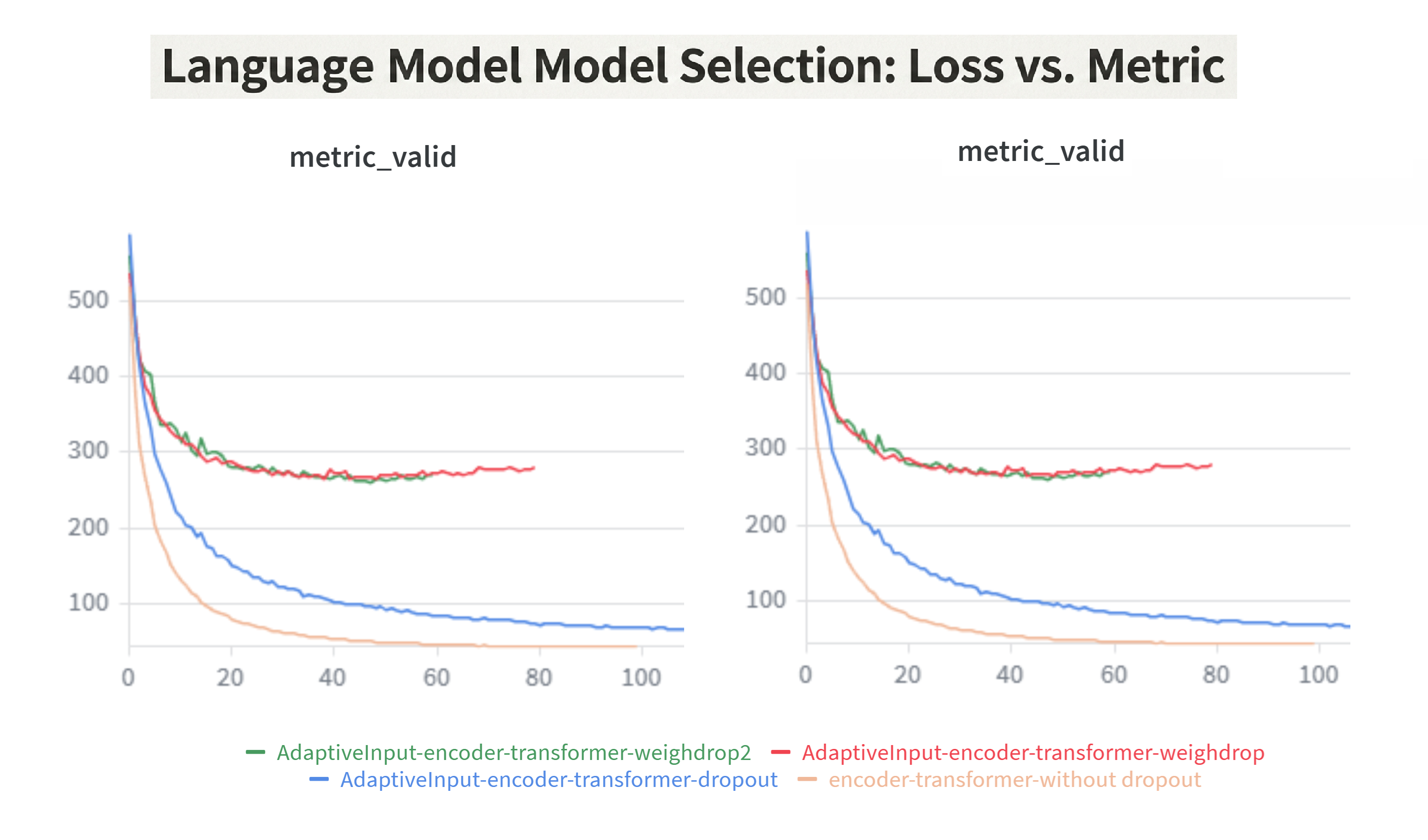
- Metric: Perplexity (PPL) — calculated dynamically as exp(loss) via CrossEntropyLoss.
- Experiment Telemetry: Fully instrumented with Weights & Biases (WandB) for epoch-level tracking of train/val loss and perplexity.
- Smart Checkpointing: Saves complete operational states (weights, optimizers, schedulers). Files are dynamically named by validation loss (e.g.,
TR4.312.pth) for instant identification of top-performing iterations. - Strict Reproducibility: Deterministic execution enforced via fixed seeds across NumPy, PyTorch, and CUDA backends.
- Inference & Tuning:
generate.pyhandles nucleus and temperature sampling for qualitative analysis, whileHP.pyorchestrates systematic hyperparameter sweeps (LR, weight decay, dropout).