Edge AI Face Recognition System
📌 Overview
Most face recognition projects lean on public benchmarks — clean, well-lit, studio-quality images that bear little resemblance to real deployment conditions. This project takes the opposite approach: the dataset was collected from scratch, capturing real subjects under varied lighting, distances, angles, and environmental conditions via video recording. This deliberate collection strategy is what drives the system’s robustness — not just the model architecture.
The result is a complete, self-contained pipeline covering every stage: dataset construction, embedding generation, identity enrollment, and real-time recognition.
📦 Custom Dataset — Built from Video
The most consequential engineering decision in this project was rejecting off-the-shelf datasets entirely.
The collection workflow (vid2imgs.py): Video footage was recorded of each subject across diverse real-world conditions — varying distances from camera, different ambient lighting (indoor, outdoor, artificial), multiple head angles, and partial occlusions. vid2imgs.py then processes each video file with cv2.VideoCapture, iterates over every frame using a tqdm-tracked loop, and writes each frame as a uniquely named .jpg into a per-identity subdirectory (./dataset/{id}/). The naming convention — {video_name}_{frame_index:04d}.jpg — ensures deterministic ordering and zero filename collisions across subjects.
This approach yields hundreds to thousands of training samples per identity from a single recording session, with natural variation that no static photo collection can replicate.
Why this matters: A model trained on posed photographs memorizes appearance, not identity. By training on frames sampled from continuous video, the model learns to recognize a person across the same intra-class variance it will encounter at inference time — motion blur, partial profiles, and inconsistent illumination included.
🧠 Recognition Pipeline
Stage 1 — Face Detection: MTCNN
The Multi-Task Cascaded Convolutional Network runs a three-stage cascade (P-Net → R-Net → O-Net) to simultaneously localize faces and predict 5-point facial landmarks for alignment. MTCNN is initialized with deliberately permissive thresholds ([0.4, 0.5, 0.5]) and a min_face_size of 60px to handle subjects at varying distances from the camera — a direct consequence of how the dataset was collected.
A custom detect_box method is monkey-patched onto the MTCNN instance via MethodType, fusing detection and crop extraction into a single call and eliminating redundant forward passes during the real-time loop.
Stage 2 — Embedding Generation: InceptionResnetV1
Aligned face crops are passed through an InceptionResnetV1 backbone pretrained on VGGFace2 (3.3M images, 9,000+ identities), producing a 128-dimensional embedding vector per face. This pretrained foundation gives the model strong general biometric priors, while fine-tuning on the custom dataset adapts those representations to the specific identities and conditions in scope.
Enrollment (embedding.py): For each subject, embedding.py replays the source video through the full MTCNN → ResNet pipeline, extracting one embedding per successfully detected frame. Each embedding is stored as a row in a pandas DataFrame and persisted to a CSV (data1.csv), indexed by subject ID. This gives the recognition stage a dense, variance-rich reference set rather than a single averaged template.
Stage 3 — Identity Matching (recog.py)
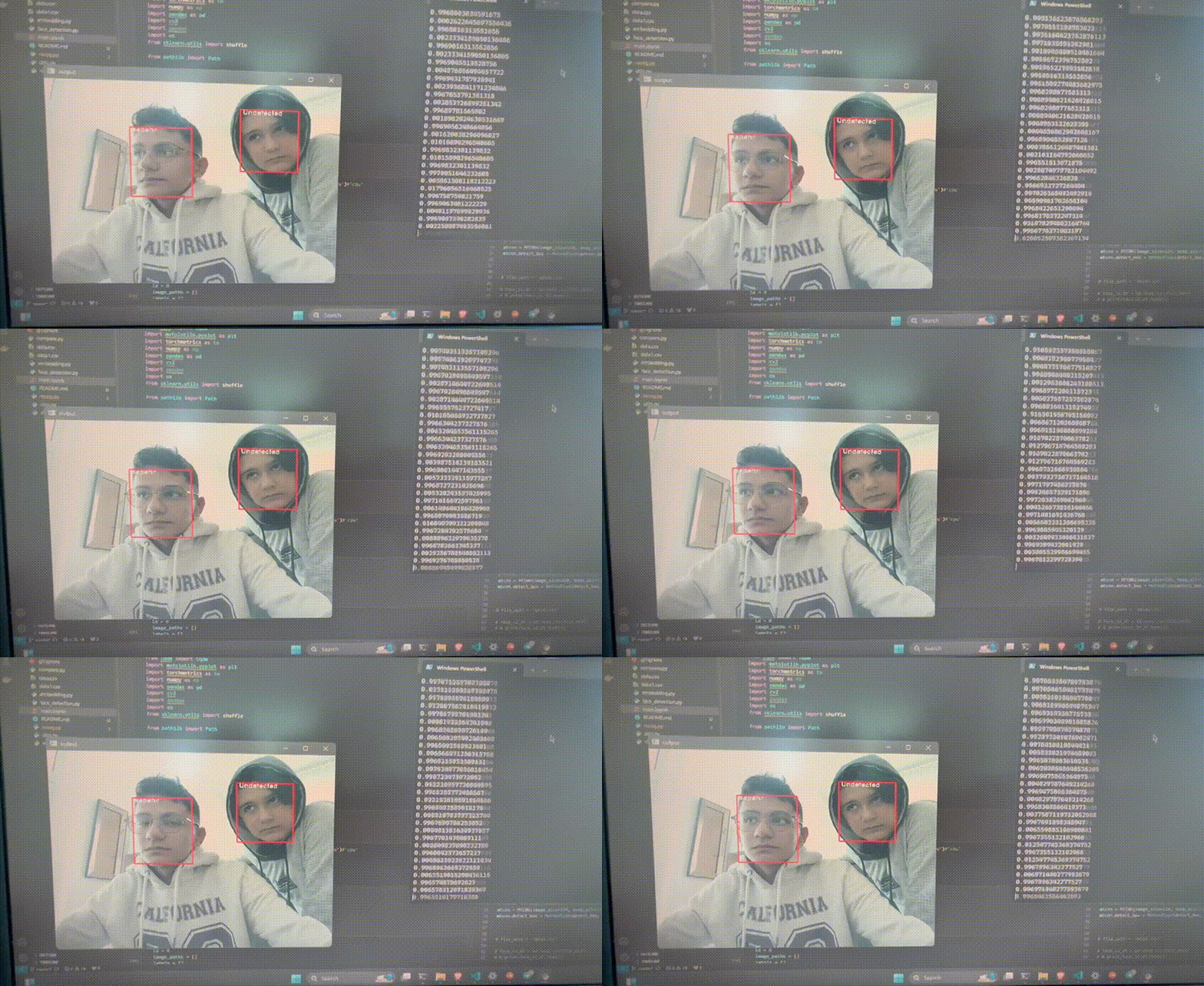
At inference time, the live frame embedding is passed through a sigmoid-activated head fine-tuned on the custom dataset. A confidence threshold of pred > 0.98 gates the final authorized/unauthorized decision — a deliberately high bar chosen because the training data’s real-world variation means a genuine match will score consistently high, while impostors fall well below it.
🗂️ Codebase Structure
| File | Role |
|---|---|
vid2imgs.py | Dataset construction — video-to-frame extraction with per-identity folder organization |
embedding.py | Enrollment — generates and persists per-subject embedding databases from video |
recog.py | Real-time inference loop — live MTCNN detection, encoding, and identity decision |
face_detection.py | Isolated MTCNN validation — standalone bounding box visualization for dataset QA |
compare.py | Embedding distance analysis — threshold calibration and pairwise similarity inspection |
utils.py | Shared helpers — checkpoint loading and model state restoration |
main.ipynb | Exploratory notebook — architecture experiments and qualitative embedding analysis |